
Pinot Noir d
There are grape varieties that are needed, and others that are waiting. The Alsatian Pinot Noir waited five centuries, under the white vines, to be listened to. In Orschwihr, he found his place: a dry hill, an ancient limestone, a fine rust-coloured clay skin.
The Pinot Noir in Alsace: a memory older than anyone believes
It is sometimes said that Alsace is a land of whites. The archives tell something else. In the cellars of abbeys as in the records of tithes of the Middle Ages, the red wine constantly returns, and it is claimed « Good » : Boni vini rubei. Canon Médard Barth, a great historian of the Alsatian vine, already saw a noble grape in the Holy Family by Martin Schongauer, painted around 1480.
The grape variety then bears another name: Klevner, Burgundy Rote. A mention of « Klebroth » from 1318 on in the archives of Salem Abbey. In 1575, Riquewihr's ordinance ordered the « Pinot rouge » among the authorized grape varieties, those that one wants to keep. The lords of Ribeaupierre, familiar with the court of Burgundy, make it a wine of appartment.
« To obtain great red wines, iron is required in a soil that is largely provided with limestone. »Conclusion of a study on the red terroirs of Alsace, reported by Organic paths in Alsace
The Pinot Noir Alsatian
- 1318 — « Klebroth » (Pinot Noir) cited in the archives of Salem Abbey.
- 1575 — Riquewihr authorizes the « Pinot rouge » in his winery.
- 1969 — Pinot Noir falls to about 2% of Alsatian production.
- AOC Alsace — Only red allowed: its durability is guaranteed.
- 2018 — It reaches about 10% of the area planted.
- 2022 — First harvest of Pinot Noir Grand Cru in Alsace (Kirchberg de Barr, Hengst).
Source: « History and future of the red wine of Alsace », Organic paths in Alsace.
Then came wars, crises, the preeminence of white. Only a few villages remained red. But the wire did not break: it was re-erged by a generation of winegrowers who searched, plot after plot, where Pinot Noir had always been home. The answer was often in two words: limestone and Iron.
The Bollenberg: Geology as the first sentence
Triangular, capped by its chapel, the Bollenberg peaks at 363 m. Protected by the Grand Ballon and Petit Ballon, it receives 400 to 500 mm of rain per year: one of the driest hills in France. Here the vine descends for water. That's exactly what a Pinot Noir requires.
A hill of several eras
Under the vine, time is stacked like the leaves of an ancient book.
The hill in strata (approximate markers)
| Era / period | Approximate age | What she leaves at the Bollenberg |
|---|---|---|
| Upper Trias — the Keuper (Mesozoic) | about -237 to -201 million years | Rich clays and blue marnes. At the Luft, they form 2.5 m of water reserve before the stone. |
| Jurassic (Mesozoic) | about -201 to -145 million years | Marine limestone, particularly in the Neuberg: structure of the hill. |
| Eocene – Oligocene (Cenozoic) | about -50 to -23 million years | The Rhine ditch collapsed and the Vosges uprising. The layers are raised and exposed. |
| Calcareous alteration (Cenozoic, until today) | over millions of years | The limestone dissolves slowly and leaves a residue of ferruginous, rusty and ochre clays. |
Ferruginous clays: the reddish skin of limestone
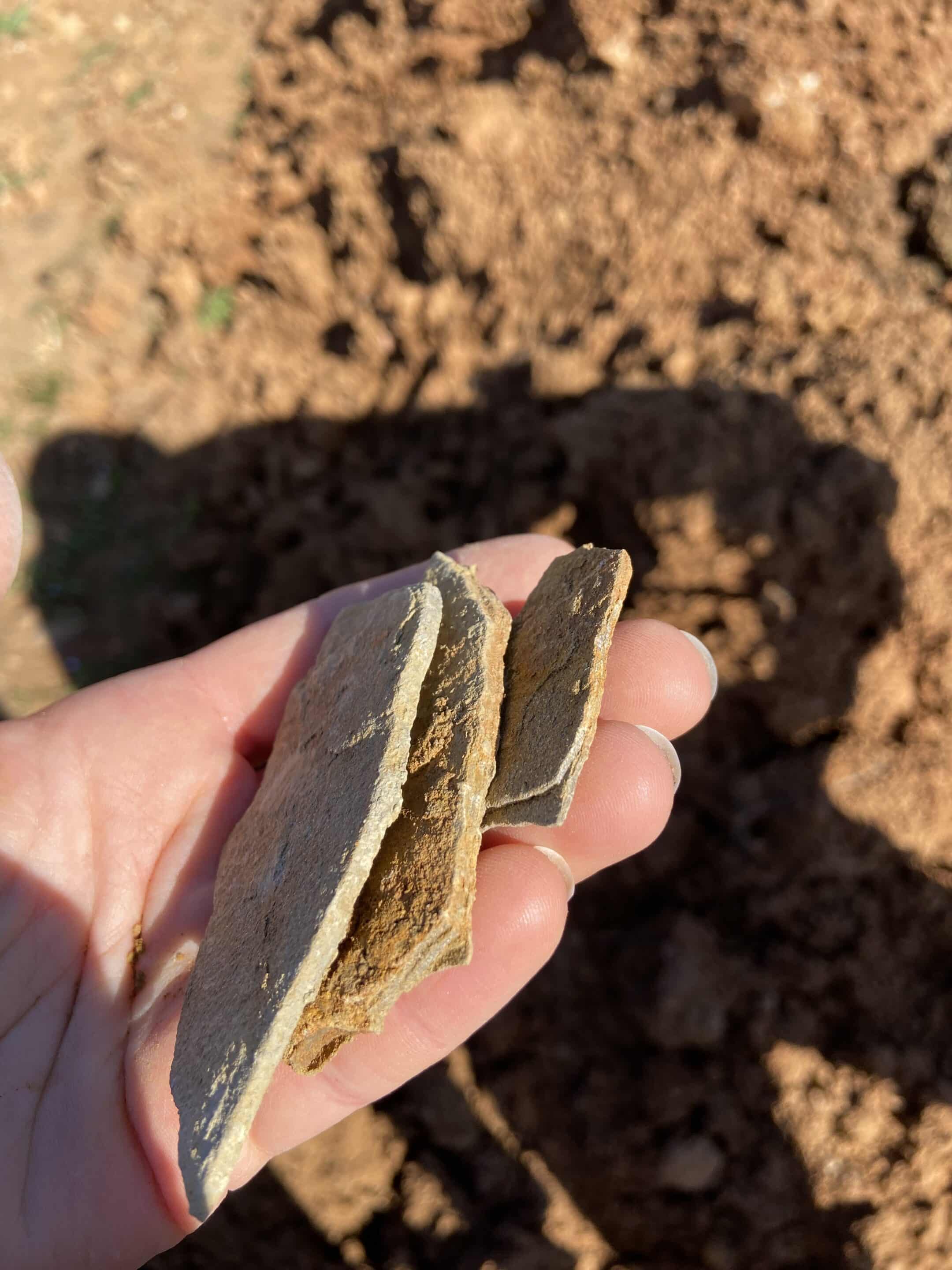
In the Neuberg, facing east, the Jurassic limestone outcrops. The soil is just skin: a thin layer of ferrous clay laid on the rock. This rust color has a story. For millions of years, the rain slowly dissolves the limestone. It takes the calcite and leaves on site what does not dissolve: fine clays, loaded with iron oxides. The ground blushes, like a stone that keeps the memory of the fire.
This land has three virtues for Pinot Noir.
- Iron. The Alsatian winegrowers mentioned above say this is essential for the polymerization of tannins and anthocyanins, therefore for the keeping of colour and grain.
- Fine clay. It gives flesh, pulp. In Sonnenglanz, limestone fed fine clays « gives bone pulp ».
- The underlying limestone. It brings tension, salinity, freshness of acidity.
Country profile — Pinot Noir du Bollenberg
HillBollenberg, Orschwihr — 363 m ExposureSud-est Parcelle41,13 ares, planted in 1998 SoilsCalcary, ferruginous clays, marnes Pluviometry400 to 500 mm / year CultureBiological and biodynamic (Ecocert, Demeter) HarvestsManuals
Find the Bollenberg on Google Maps
In the glass: a Black Pinot of dry hill
Pinot Noir du Bollenberg was planted in 1998. She must have gone to get, very deep, what the hill does not give easily. You can feel it on the nose: peony, sour cherry, currant, strawberry, rosewood, fine spices and a dry garrigue note. In the palate, the attack is tender and fruity, delicate medium. The tannin grain is silky, and the final vibrates like a violin rope.
This reading joins that of Manuel Peyondet, Best Sommelier de France 2008 and Best Worker de France 2011. He tasted the 2023 vintage during a tasting in Paris, and he says:
« There, I flashed: a floral atmosphere to be damned, with a blood tip, and this menthol fiber that lies right on a material as greedy as persistent. After this flash, I went back to the end of the living room to be sure of my sensations, and the confirmation was brilliant. »Manuel Peyondet, Bollenberg Pinot Noir 2023 — 92/100, La Revue du Vin de France n°694
He also mentioned an area of « which will not do in the figure in the contemporary offer of Alsace ». For the following vintage, he writes: « With a range of black pinots disarming with pleasure and sincerity, Annabelle Braun makes a bursting entrance into my most beautiful strokes in Alsace! » (D'oeuvre).
Table
- Temperature: 16 °C, in a beautiful glass of Burgundy.
- Carafage: 15 to 30 minutes in youth.
- Agreement: colvert fillet with spices, beet cream (suggestion) Roasted poultry, mushrooms, soft cheeses also work.
Camille Braun: a transmission, a wire found
Orschwihr, 1593: The family arrives from Switzerland. For a long time, it's polyculture. Then Camille Braun and Marguerite Noll choose the vineyard alone, out of conviction. Christophe returns in 1987, biodynamics is needed, and the estate extends over 15 hectares, patchwork of plots around the village.
In 2023, Annabelle returned. She did her classes in Burgundy, at Christophe Roumier and at Cécile Tremblay: the Pinot Noir school that talks about places rather than recipes. The thread of Alsatian history, broken for centuries, reconnects here in patience: an ancient grape variety, a dry hill, a soil of rust and stone, and hands that can erase.
Hand harvested, slow-breeding in lightning, no oenological input, a veil of sulphur if the wine asks: Pinot Noir du Bollenberg does not add anything. He reveals.
Discover Pinot Noir Bollenberg · Bollenberg Hill · The Neuberg · The Sonnenglanz · The Luft
Frequently Asked Questions
Can we make great Pinots Noirs in Alsace?
Yes, when the soil is ready: limestone for tension, iron for tannin structure, dry climate for concentration. This is what the Bollenberg brings together.
What is iron clay?
These are clays rich in iron oxides, resulting from the slow dissolution of limestone. They give the soil a red colour and, in wine, flesh and clothing.
What is the profile of Pinot Noir du Bollenberg?
A light and deep red, floral and sour (piony, cherry, rosewood), with silky tannin grain and a tense finish, salty.
Where's the Bollenberg?
In Orschwihr (High Rhine), at the foot of the Vosges. See map.