
Wines of the Bollenberg Hill

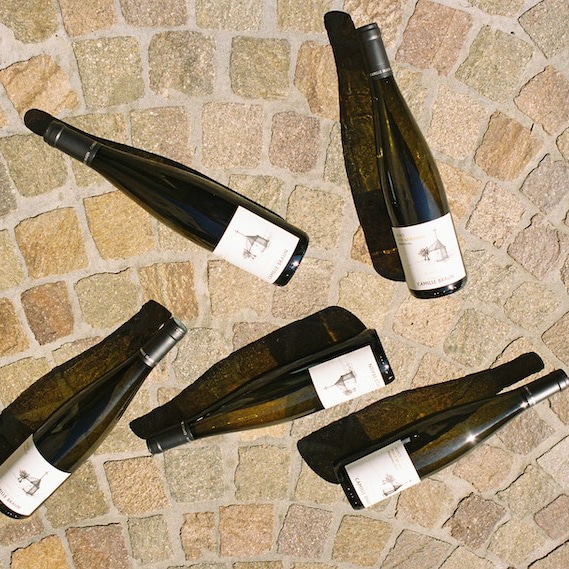
WHITE PINOT
Surface: 58ares
Year of planting: 1973
Exposure: South-east
The white pinot finds on the Bollenberg a kind of middle: neither demonstrative nor erased. On the nose, we're on the fresh pear, the juicy apple, a note of white flowers and a nothing wet chalk. In the palate, the wine advances over the assumed discretion: a tender matter, supported by acidity more present than it seems. The limestone of the hill gives this tactile side, almost powdered, that stretches the final. A wine of soft light, more nuanced than relief, that accompanies the table with a disconcerting ease without ever giving up its outfit.
MUSCAT
Surface: 52.8 ares
Year of planting: 1984 and 1987
Exposure: South-east
A hillside nutmeg, which knows the sun but keeps the Bollenberg. The nose overflows with crucified clusters, vine flowers, candied citrus fruits and light mint: everything says the grape variety, but without added sugar. In the palate, the aromatic stretch, but the mouth remains dry, clean, carried by a freshness of limestone. The relief of the hillside brings a little tension, almost salivating, that balances the generosity of the perfume. It is a wine of clarity: very expressive in the nose, surprisingly straight in the finish. The kind of muscat that prefers the sharp trait to the lexuberance.
RIESLING
Surface: 101.39 ares
Year of planting: 1973, 1976 and 1977
Exposure: South-east
The riesling, here, speaks the language of the Bollenberg hill: clear stone, light, wind. The nose mixes fresh lemon, zest, rubbed stone, sometimes a hint of vervein or flower dacacia. From the outset, it is felt that the wine will be more traced than round. The mouth confirms: a straight attack, a fine but firm acidity, a stretched material that never seeks width but length. The limestone gives this salty side, almost biting, which makes salivate and calls the next sip. It is a light voltage riesling, which prefers the clear line to the opulence, and which increases in complexity over time rather than with volume.
PINOT GRIS
Surface: 95.64 ares
Year of planting: 1986
Exposure: South-East and West
Taken between two lights, the grey pinot of the Bollenberg plays on two registers: the southeast face for maturity, the west for restraint. On the nose are the ripe mirabelle, the candied pear, a hint of smoky and sweet spices. In the mouth, the matter is ample, but held. The limestone keeps its hand, engraves the wine in a vertical dynamic that avoids heaviness at all times. A small noble bitterness in the finish comes to tighten the mouth and prolong the memory. It is a grey hillside pinot: more in texture than in sugar, more in relief than in easy roundness.
Gewurztraminer
Surface: 71.69 ares
Year of planting: 1983, 1984 and 2006
Exposure: East/Southeast
The Bollenberg gewurztraminer looks east, but with limestone discipline. The nose is generous – pink, litchi, fruit of passion, orange bark, sweet spices – but the aromatic, here, never overflows with its glass. In the palate, the natural richness of the grape variety is framed by the freshness of the slope. Sugar, when there is one, is integrated into a large but clear texture; A fine bitterness of zest and a discreet salinity come to sign the terroir. A gewurztraminer who keeps from the climate his generosity, and from the hill his outfit: sensuality held by the stone.
BLACK PINOT
Surface: 41.13 ares
Year of planting: 1998
Exposure: South-east
A black pinot of dry hill, where the vine must go for deep. In the nose, the peony is next to the acidic cherry, the currant and the strawberry of the woods, while the rose wood is outcropped, carried by fine spices and a note of dry garrigue, reminiscent of the molluscs of the Bollenberg. In the palate, the tender and fruity attack opens on a sweet, delicate medium, where floral and vegetable tones lengthen. The tannin grain, silky and polished, carries a concentration while finesse. The final vibrates like the string of a violin: salivating, it stretches away, revealing the nobility of the climate.